Diagnosing failing ignition coil vs starter solenoid - click when turning key, cranks after multiple attempts

Disclaimer: Links on this page pointing to Amazon, eBay and other sites may include affiliate code. If you click them and make a purchase, we may earn a small commission.

CSX55

Newbie
Joined
Nov 4, 2014
Messages
12
Reaction score
14
My '99 Tahoe has been getting increasingly more hit or miss when it comes to starting. Turn key, single click, but within a few more turns/clicks, it'll turn over as normal. Battery is in good shape, all terminals are tight.

Today, it got to the point where it took probably 30+ attempts to finally crank - still getting just a single click upon each attempt. Trying to determine if I should be looking at the starter or the ignition coil; any advice on how to compare the failure modes? I've read conflicting reports on whether a bad ignition coil will produce the click. Hoping it's a starter given that it's comparatively simple to R&R.

Thank you!
 

Erik the Awful

Truly Awesome
Air Force Supporting Member
Joined
Aug 9, 2019
Messages
10,038
Reaction score
23,545
Location
Choctaw, OK
From your description, the most likely culprit is a bad connection. Did you put a battery brush in the battery terminals to ensure they're clean? Is there any crud growing back into the wires? Is your engine grounded well? How do you know the battery is good? Did you use a battery tester that puts a load on it?

Not trying to cast doubt on your abilities, just asking the simple questions first. It's possible your starter solenoid's contacts aren't contacting reliably, but it's usually a battery cable issue.
 

HotWheelsBurban

Gotta have 4 doors..... Rawhide, TOTY 2023!
Joined
Sep 18, 2019
Messages
17,321
Reaction score
46,250
Location
Houston, Texas
The battery cables on these trucks are notorious for getting corrosion down inside the insulation where you can't see it. I've had this happen on my Burb in early last year. Like Erik said, the starter solenoid could be bad, but check your cables and grounds.
If you can get the starter off, do you have a way to get to a parts store that can check it by running it on their tester? Sometimes a bad starter has to be checked several times, so that it's warmed up good, to verify that it has a problem that may only present when the unit is hot.
 

stutaeng

I'm Awesome
Joined
Aug 7, 2019
Messages
3,399
Reaction score
4,412
Location
Dallas, TX
I think when my starter went out it just didn't do anything. I was at work and when my wife showed up to pick me up I remembered the old trick of wacking it with a hammer.

I had my wife continuously engage the ignition switch while I tapped the starter with a wrench and she started right up. When I got home I headed to the local parts store for a remanufactured replacement.

On the same truck but much longer time ago a little after I had bought it, my ICM died and the truck stalled, leaving me stranded. Luckily I was a few blocks from home and Dad pulled me home with his truck. I was so green then that I didn't even know how to do basic things such as checking for spark. My mechanic quickly figured it out though.
 

Erin

I'm Awesome
Joined
Sep 30, 2017
Messages
2,385
Reaction score
6,071
Location
Southwest Louisiana
I think when my starter went out it just didn't do anything. I was at work and when my wife showed up to pick me up I remembered the old trick of wacking it with a hammer.
Same here. I bought a battery first, thinking that was the problem. My dad suggested starter, which I hadn’t even considered. So, I ended up with a new battery & starter.
 

stutaeng

I'm Awesome
Joined
Aug 7, 2019
Messages
3,399
Reaction score
4,412
Location
Dallas, TX
Yeah, definitely look at the starter. I went back to re-read your post and realized that the ICM would not be the problem in your case. ICM is responsible for sending signal to the coil to produce spark. What you describe is that truck fails to turn over, right?

Get yourself a test light and go underneath and check for ground, 12V+ and the signal. Ground and 12V+ should always be present on those big cables. The signal wire goes to the solenoid. Have a helper cycle the ignition while you check for power. You can use long test leads and locate the test light on your dash if you are working solo. That would conclude if it's the starter or some other thing like a relay or ignition switch.
 

GoToGuy

I'm Awesome
Joined
Sep 16, 2020
Messages
7,332
Reaction score
11,920
Location
CAL
Test ignition control module, good battery, good cables power and grounds. At starter ensure full voltage to solenoid control wire. Solenoid engages than next would be motor. Breaking down winding s loss of field voltage?
 

454cid

Sooper Pooper
Supporting Member
Joined
Sep 5, 2010
Messages
10,526
Reaction score
15,300
Location
The 26th State
Test ignition control module...

His ICM, good or bad, is not preventing his engine from cranking.

OP, that sounds like the starter, or the starter solenoid. If it's the solenoid, I suggest just getting the whole starter. It's possible it could also be the trigger wire, but I've never experienced that.

When mine went, it would always start right up at home. Then when I was elsewhere it would be dead, and I'd have to hit the key many times. When it was getting to the end, hitting the starter while turning the key would get it going... unfortunetly that's a two person job. When I tried taking my soliniod off the starter I started snapping the little bolts, so I just got a new starter. Later, I found the contacts in the solenoid were completely worn out.
 

GoToGuy

I'm Awesome
Joined
Sep 16, 2020
Messages
7,332
Reaction score
11,920
Location
CAL
With available warranties from various manufacturers, and reliability value away from home base, the replacement of starter/solenoid as a single unit is good decision. My 95 K2500 5.7 began to take 2 or 3 times cycling the key to turn and start. As power at power at purple wire then through the solenoid contacts when cycling the key. One day prime delivery new AC Delco starter, 24 mos warranty, prepaid Delco return, and 25$ rebate. A small victory. One of few.
 

CSX55

Newbie
Joined
Nov 4, 2014
Messages
12
Reaction score
14
Thank you for all the quick replies everyone! A few answers to specific questions:

Is the starter original?

Yes, original starter, Tahoe currently at 141k miles.

From your description, the most likely culprit is a bad connection. Did you put a battery brush in the battery terminals to ensure they're clean? Is there any crud growing back into the wires? Is your engine grounded well? How do you know the battery is good? Did you use a battery tester that puts a load on it?

Not trying to cast doubt on your abilities, just asking the simple questions first. It's possible your starter solenoid's contacts aren't contacting reliably, but it's usually a battery cable issue.

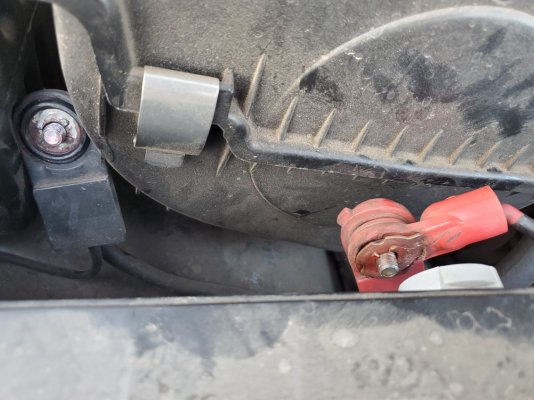
Pulled both terminals at the battery, visually inspected connections at starter, verified grounds and terminals are all tight. No white crud on any connections - see attached for a pic of the terminals. Battery is under a year old and maintains 10V or greater throughout the cranking cycle, verified with a multimeter - not a true load test but I would think I'd be seeing a much greater voltage drop during crank if the battery was suspect. I'll see about taking it somewhere for a true load test if I don't find any other smoking guns.

Yeah, definitely look at the starter. I went back to re-read your post and realized that the ICM would not be the problem in your case. ICM is responsible for sending signal to the coil to produce spark. What you describe is that truck fails to turn over, right?

Get yourself a test light and go underneath and check for ground, 12V+ and the signal. Ground and 12V+ should always be present on those big cables. The signal wire goes to the solenoid. Have a helper cycle the ignition while you check for power. You can use long test leads and locate the test light on your dash if you are working solo. That would conclude if it's the starter or some other thing like a relay or ignition switch.

Correct - truck fails to turn over during a no-start condition. Key in, turn key to start, all I'll get is a single "click". Multiple repeated attempts to get it to crank will result in the same single click each time, until it finally turns over as normal. It has yet to fail to start, and the condition is intermittent - sometimes it starts up first try, no hesitation, other times it can take anywhere from 3 - 30 attempts to get it to turn over.
 

Attachments

  • 20210910_181646.jpg
    20210910_181646.jpg
    287.1 KB · Views: 9

CSX55

Newbie
Joined
Nov 4, 2014
Messages
12
Reaction score
14
Well I just attempted to measure for +12V at the starter per some of the above suggestions...but of course, she's starting up every single time now. The problem seems to go away during "hot" conditions - once it's started once, it'll continue to start.

Sounds like a dead spot in the starter to me too.

I'm curious about what type of failure a "dead spot" is, mechanically speaking - does that mean there's a broken/worn tooth that is preventing the engine from cranking on when it lands on that spot, or is it something else?
 

HotWheelsBurban

Gotta have 4 doors..... Rawhide, TOTY 2023!
Joined
Sep 18, 2019
Messages
17,321
Reaction score
46,250
Location
Houston, Texas
Something else I found when my Burb was behaving badly last year: the small terminal on the starter solenoid was loose( the threaded post). I tightened it up with my small vise grips on the sheet metal but that holds it into the solenoid cap. This wire goes to the ignition and activates the solenoid, making the plunger pull the drive gear into the flywheel. My truck had several issues before I got it ( that's probably why PO sold it) that eventually damaged the flywheel teeth and the starter. So I've always been attuned to any starting issues, since I don't enjoy crawling under it to R&R the starter....
I replaced the long + cable that goes across the fan shroud and over to the computer. Got a shop to make me one for under $15, from bulk 4 ga. cable and new terminals. I also cleaned and checked all the connections and grounds as I put it back together. Intermittent electrical problems like this are hard to diagnose, but very satisfying when you do get it sorted out.
The symptom that it's temperature related makes me think there's a loose connection or broken wire that makes contact when hot and doesn't when cold. The starter armature can get damaged, and maybe it has this type of problem.
 

Schurkey

For a pacifist, I sure am a radical mother...
Supporting Member
Joined
Jan 14, 2018
Messages
17,641
Reaction score
27,305
Location
The Seasonally Frozen Wastelands
There is no possible way this has anything to do with the ignition coil, ignition module, or anything else in the ignition system proper.

We're told that the solenoid clicks. Therefore the ignition switch, neutral safety switch, and starter relay are working. The purple wire between the relay and the S terminal of the starter solenoid is carrying at least some current.

The 95% likely fix for this is to replace the starter and solenoid. There was a time when replacing only the solenoid might take care of the problem--but nobody replaces just the solenoid any more; and at a hundred-forty thousand miles, I wouldn't keep the starter after going to the trouble of removing it to scrap just the solenoid.

I'm curious about what type of failure a "dead spot" is, mechanically speaking - does that mean there's a broken/worn tooth that is preventing the engine from cranking on when it lands on that spot, or is it something else?
There are two possibilities for a "dead spot". One in the starter solenoid--there's a relatively large copper disc that gets pushed into stationary copper contacts. The disc is free to rotate; but there's no mechanism that forces rotation. If the copper disc or the contacts it's pressed against develop a burnt spot, the starter drive gets shoved into engagement--but the motor gets no power so the starter motor doesn't turn. Click!---then nothing happens. Just exactly like what you have now. Maybe there's enough vibration to turn the copper disc a little--now the burnt spot isn't aligned with the other contacts, and the starter motor works normally.

Photos of ancient, easily-disassembled old-style starter solenoid:
You must be registered for see images attach


You must be registered for see images attach


You must be registered for see images attach


OR

The starter motor has a certain number of armature bars. Each bar is connected to armature windings. Electric power flows through each pair of bars in turn as the motor spins. If there's an open in the wiring between a pair of armature bars, those two bars are "dead". The starter motor may spin fast enough that those dead armature bars don't contribute to starter motor power; but the motor still spins with reduced power because all the other bars are working. However, if the motor happened to stop spinning with the dead armature bars aligned with the brushes; the starter would never begin spinning.

In one situation, you'd need a new solenoid; or at least polish the copper disc and it's stationary contacts to make it conductive again. Nobody does that--it's not economically viable if your labor is worth anything.

In the other situation, you'd need a new starter armature. Almost nobody fixes starters piece-by-piece any more. Again, it's not economically viable if your labor is worth anything; and it's hard to buy just a replacement armature.

So either way, you're trading off the starter/solenoid for a new or rebuilt starter and solenoid.

 
Last edited:

Schurkey

For a pacifist, I sure am a radical mother...
Supporting Member
Joined
Jan 14, 2018
Messages
17,641
Reaction score
27,305
Location
The Seasonally Frozen Wastelands
You must be registered for see images attach


One more photo.

The "S" terminal gets power from the ignition switch. The big lug at the top is powered all the time via the heavy + battery cable.

When the S terminal is powered, the solenoid windings pull in the plunger, which knocks into the copper disc, and also pushes the starter drive into engagement with the flywheel teeth.

When the copper disc gets crammed against the other contacts--the main power input, for the R terminal and for the motor terminal (at the bottom, removed in this photo) the main power input energizes the entire copper disc which then provides that power to the R terminal, and the motor also gets power to spin.

All that magic happens AFTER the S terminal is powered by the ignition switch--the starter drive is forced into the flywheel BEFORE the rest of the system gets power.

The "R" terminal isn't used on most vehicles built since '75. The newer solenoids only have the main power lug, the motor lug, and the S terminal.
 

HotWheelsBurban

Gotta have 4 doors..... Rawhide, TOTY 2023!
Joined
Sep 18, 2019
Messages
17,321
Reaction score
46,250
Location
Houston, Texas
You must be registered for see images attach


One more photo.

The "S" terminal gets power from the ignition switch. The big lug at the top is powered all the time via the heavy + battery cable.

When the S terminal is powered, the solenoid windings pull in the plunger, which knocks into the copper disc, and also pushes the starter drive into engagement with the flywheel teeth.

When the copper disc gets crammed against the other contacts--the main power input, for the R terminal and for the motor terminal (at the bottom, removed in this photo) the main power input energizes the entire copper disc which then provides that power to the R terminal, and the motor also gets power to spin.

All that magic happens AFTER the S terminal is powered by the ignition switch--the starter drive is forced into the flywheel BEFORE the rest of the system gets power.

The "R" terminal isn't used on most vehicles built since '75. The newer solenoids only have the main power lug, the motor lug, and the S terminal.
Excellent explanation,Schurkey! I have taken a couple of the GM starters apart, and Dad used to rebuild them. Our 79 Burb, that's what he had to do since it had a modified drive end frame ( truck had a Goodwrench 350 in it, and the block had cracked around the starter mounting area, so some PO had welded a stud in the block and an extra ear on the end frame to fit it).
 

Schurkey

For a pacifist, I sure am a radical mother...
Supporting Member
Joined
Jan 14, 2018
Messages
17,641
Reaction score
27,305
Location
The Seasonally Frozen Wastelands
Dad used to rebuild them.
"Used to" is right. Nobody rebuilds an individual starter any more. Not even close to cost-effective...


...says Schurkey, who has three little drawers full of starter brushes, starter bushings, shift forks, a starter drive or two, and leather washers.

OK, in my defense, I don't do it to make money. And rebuilding those heavy, ancient 10DN direct-drive starters is still useful when working on Olds, Pontiac, or Cadillac engines. But if you're dealing with a Chevy or Buick engine, the 10DN goes in the parts pile in favor of a GM-engineered Permanent Magnet Gear Reduction (PMGR) "mini" starter. The PMGR starters are half the weight, 2/3 the amperage draw of the old in-line, direct-drive starters. The motor has half the torque, but three times the RPM. So add a gear reduction to drop the rpm and beef-up the torque; you've got a light-weight high-power compact unit that doesn't make your sphincter pinch when you lift it into place. Unfortunately, GM doesn't have nose-cones to fit Olds or Pontiac or Cadillac.
 
Last edited:

Erik the Awful

Truly Awesome
Air Force Supporting Member
Joined
Aug 9, 2019
Messages
10,038
Reaction score
23,545
Location
Choctaw, OK
Seventeen years ago, give or take some months, I was bench-pressing the starter into my '69 Cadillac. It wasn't going in and got wedged. My arms were aching, so with the starter wedged, I dropped one of my arms for a rest. A few seconds later the starter fell and landed on my upper lip. It loosened one of my front teeth. My lip was busted up, bad, and I had a date that night. That was my first date with my wife. Fortunately, she saw past the busted lip.

There is a gear reduction starter available for the big block Cadillacs, but I don't see it on RockAuto. I have one for the Jaguar, and it's a God-send compared to that thirty-pound direct drive turd. If there's a gear reduction starter available, there's no reason to buy a direct drive.
 

Latest posts

Forum statistics

Threads
78,085
Messages
1,644,810
Members
81,216
Latest member
spaglioni
Top